
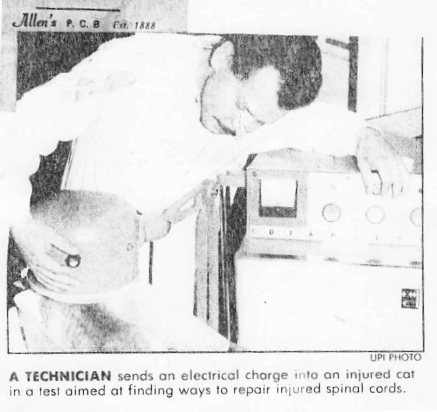
SAN FRANCISCO (UPI) – Studies show the use of radio waves helps cats walk crippled spinal cords walk again, offering hope to the thousands of accident victims who are paralyzed each year, a noted British researcher reported Thursday.
“Our studies indicate pulsed high-frequency electromagnetic energy offers a most promising avenue to a cure of paralysis,” surgeon David Hedley Wilson said in an interview.
“We plan to begin human tests soon,” said Wilson, president of the Association of Accident and Emergency physicians of England and head of the Accident and Emergency Department at the Royal Liverpool Infirmary at Leeds University Hospital.
As many as 3.5 million Americans are paralyzed by central nervous system injury, with 20,000 to 30,000 new injuries occurring each year. The average victim is a 19-year-old male, with two-thirds of patients under 30.
“Now there’s hope these victims, so many stricken while young and strong, may not need to spend the rest of their lives in wheelchairs,” said Richard Keller, vice president of Diapulse Corp. of America, Great Neck, N.Y.
The company manufactures the Diapulse unit — used in Great Britain and Canada but approved only for research in the United States — which generates radio waves at 27.12 megahertz, just above the frequency of television, emitting an electromagnetic field.
“The radio frequencies are harmless, painless and can travel through dressings or plastic casts to speed recovery and repair damaged nerves,” Wilson reported at the International Symposium of the American Paralysis Association.
In treating thousands of patients with soft-tissue injuries during the past decade, Wilson found that the device quickened by as much as four times the healing process in sprains, post-operative wounds, sports, bone fractures, swollen joints.
In recent experiments Diapulse treatment started within four hours after spinal cord injury resulted in a return to total function in 50 percent of the cases, he said.
“We see it now as having enormous potential in the treatment of acute spinal injuries, with indications that it promotes the migration of nerves in injuries once thought to result in lifelong paralysis.”
In a cat study, he found Diapulse minimized scar tissue which forms a barrier to messages passing through the injury site or a spine paralyzed because of spinal cord damage, 28 were able to walk again.
Since accident victims who sustain spinal cord damage usually also suffer life-threatening injuries that need to be treated first, Wilson is now studying whether a delay between the spinal cord injury and treatment makes a difference in the result,” he said.